What is REF?
The Research Excellence Framework is an exercise which take place periodically to evaluate the quality of research in UK Universities
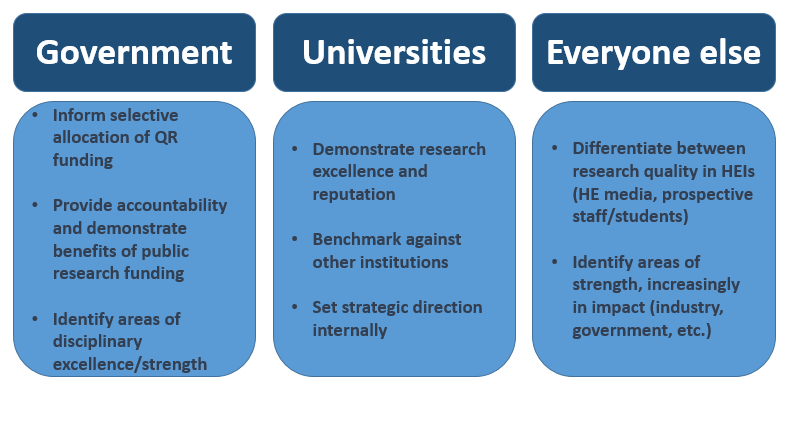
The outcomes from this exercise informs the distribution of Quality Related (QR) funding.
The results from the REF also feed into a range of Higher Education league tables and so can influence prospective staff and students when choosing where to study or work. More information can be found on the Research England website.
Research England have produced a handy document that answers some of the most commonly asked questions from academics and researchers in relation to REF 2021.
Key questions for academics and researchers
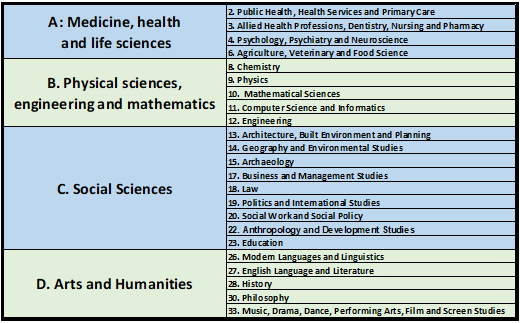
The REF exercise is an assessment in academic disciplines known as Unit of Assessments (UoAs), i.e. Law, Psychology etc
Expert panels of academics and research users undertake assessment of each UoA. Universities strategically choose which UoAs to submit to and which staff are placed in each discipline. Queen’s intends to make 25 submissions to REF 2021.
Research England have provided institutions with guidelines on staff eligibilty for REF 2021.
Category A eligible staff are defined as academic staff with a contract of employment of 0.2 FTE or greater, on the payroll of the submitting institution on the census date, whose primary employment function is to undertake either ‘research only’ or ‘teaching and research’. Staff should have a substantive research connection with the submitting unit. Staff on ‘research only’ contracts should meet the definition of an independent researcher (see section 3 of the Code of Practice).

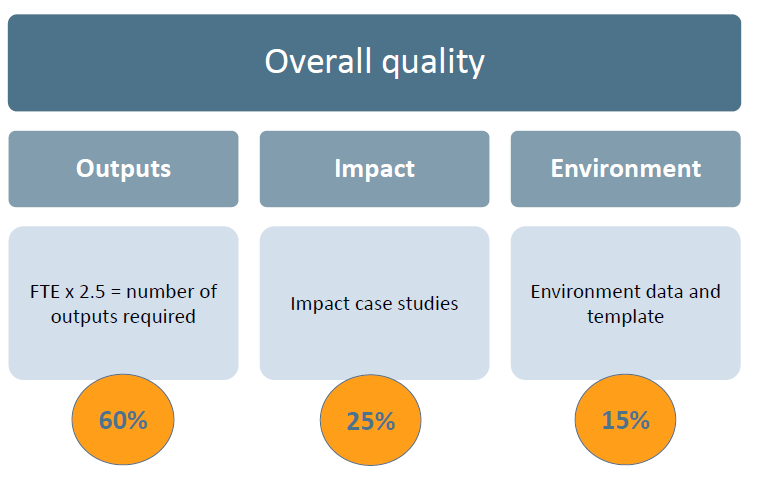
The REF submission for each Unit of Assessment is made up of Outputs, Impact and an Environment statement.
Outputs – In REF 2021 each unit will require a total number of outputs calculated by ‘2.5 x FTE’ on 31 July 2020. Each staff member will be requried to submit a minimum of one output and UoAs can submit up to a maximum of five per individual .
Impact - Impact case studies are now worth 25% of the REF assessment – a significant increase on 16% in REF 2014. This means that the value of an individual case study has increased significantly from the previous exercise. Each UoA requires a minimum of two case studies for the first 20 FTE and an extra case study for every further 15 FTE.
Environment - There are a number of changes planned to the environment section of REF. These will include the introduction of a more structured template which will require each unit to report on specific sections such as links to institutional strategy, interdisciplinary research, equality and diversity, impact, collaboration beyond HE, and open research. Further metrics will also be introduced although these are also TBC by Research England.
Research England have a timetable in place
|
DATE |
ACTION |
|
Early 2020 |
Formal release of the submission systems and accompanying technical guidance; invitation to HEIs to make submissions; invitation to nominate panel members and assessors for the assessment phase; deadline for staff circumstances requests |
|
Mid 2020 |
Appointment of additional members and assessors to panels |
|
31 July 2020 |
Census date for staff; end of assessment period (for research impacts, the research environment, and data about research income and research doctoral degrees awarded) |
|
27 November 2020 |
Closing date for submissions |
|
31 December 2020 |
End of publication period (cut-off point for publication of research outputs, and for outputs underpinning impact case studies) |
|
29 January 2021
|
Deadline for providing further details for outputs pending publication; redacted versions of impact case studies; and corroborating evidence held for impact case studies |
| Throughout 2021 | Panels assess submissions |
| December 2021 | Publication of outcomes |
| Spring 2022 | Publication of submissions, panel overview reports and sub-profiles |
This timeline details key internal milestones in the University's REF preparations and will be updated regularly.
|
March |
|
|
April |
|
|
May |
|
|
June |
|
|
July |
|
Support material and guidance specifically aimed at REF Champions.
Internal REF Planning Guidance
- Latest News
- Guidance documents - REF Planning Update (February to 31 July 2020),
- Code of Practice
- FAQs
Research England REF Guidance